How to turn your dreams into reality with AI?
How to turn your dreams into reality with AI?
Kenya Highland Coffee Farm: From Wildlife Threats to AI Security
When Security Meets Agriculture
Hand-picking strawberries traditionally requires 8 workers at $200 per day with a 30% bruise rate. Meanwhile, AI robotic harvesters cost $30,000 upfront but work 24/7 with just 2% bruise damage, paying for themselves in one season. China now manufactures these systems at one-third the cost of Israeli alternatives.
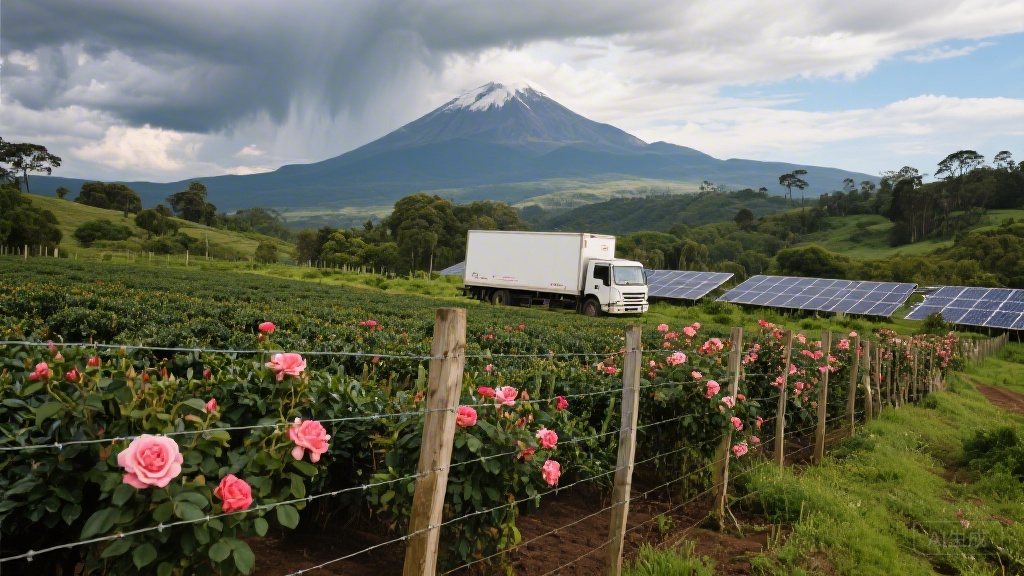
This reality of agricultural automation extends beyond harvesting to farm security—especially critical in Kenya's highland regions where wildlife encounters and security threats pose daily challenges. Our Virtual Demo Farm KE-01 demonstrates how integrated safety systems transform a vulnerable 120-hectare operation into a secure, profitable enterprise. Explore in 3D
Geographic Intelligence: Kenya's Highland Advantage
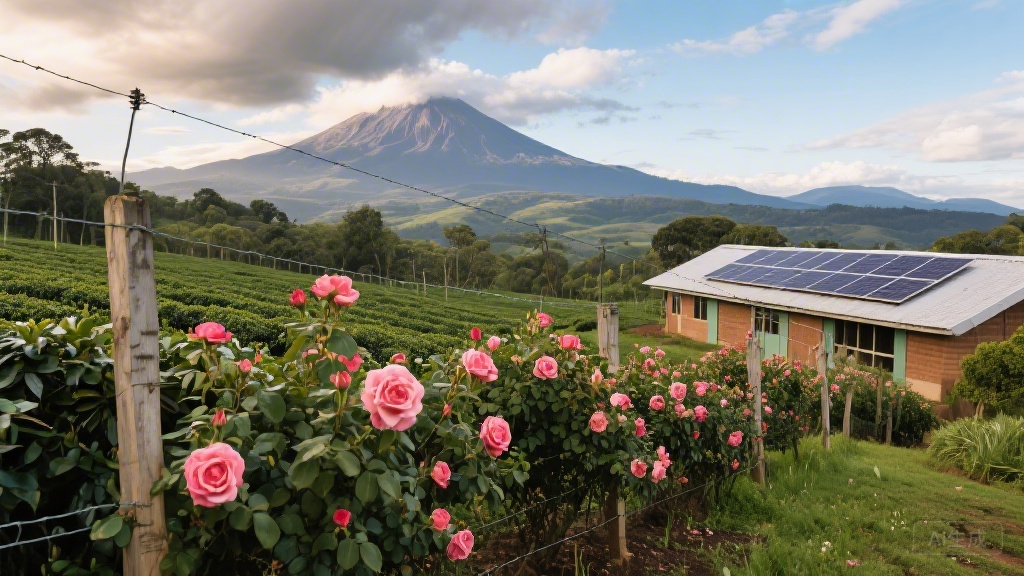
Located at GPS coordinates -0.3912, 36.9523, this farm sits in Kenya's renowned coffee belt, approximately 80 kilometers northeast of Nairobi at 1,800 meters elevation. The six-point polygon boundary encompasses prime agricultural land between the Aberdare Range foothills and Mount Kenya's southern slopes.
Google Maps satellite imagery reveals why this location commands premium prices: consistent cloud cover provides natural shade for coffee plants, while volcanic soils deliver the mineral complexity that creates Kenya AA's distinctive bright acidity. The farm enjoys direct access via the B5 highway to Jomo Kenyatta International Airport—crucial for rose exports that must reach European markets within 48 hours of cutting.
However, this prime location comes with challenges. The farm borders Aberdare National Park, creating wildlife corridors that bring elephants, buffalo, and leopards onto agricultural land. Additionally, the area's remoteness and high-value crops attract security threats. Explore this farm in 3D to understand how geography shapes security strategy.
Highland Climate: Goldilocks Zone for Premium Crops
The tropical highland climate classification delivers exactly what specialty agriculture demands: consistent temperatures between 15-25°C year-round, 1,200mm annual rainfall in two distinct seasons, and 12-hour daylight cycles regardless of season. These conditions create a 'Goldilocks zone' where coffee cherries mature slowly, developing complex flavor compounds.
The farm experiences two rainy seasons—long rains from March to May, short rains from October to December—perfectly timed for coffee flowering and cherry development. However, climate stability masks environmental risks: afternoon mists reduce visibility for security patrols, while dense vegetation provides cover for both wildlife and intruders.
Compared to similar operations in Colombia or Ethiopia, Kenya's highland farms face unique security challenges. The threat level registers as 'medium'—manageable with proper technology but requiring constant vigilance. Wildlife encounters peak during dry seasons when animals seek water sources, while security incidents often coincide with harvest periods when valuable crops are most vulnerable.
Premium Crop Portfolio: Beyond Coffee
This farm's dual focus on coffee and roses represents strategic diversification across complementary high-value crops. Kenya AA coffee commands $8-12 per kilogram for specialty grade, with 2.5 tons per hectare yielding $20,000-30,000 annually. The 'AA' classification requires beans over 7.2mm diameter—only 10-15% of total harvest—but European and American roasters pay premiums for Kenya's wine-like acidity.
Export roses generate faster returns: 150-200 stems per square meter, harvested every 6-8 weeks, selling for $0.15-0.25 per stem FOB Nairobi. Target markets include Netherlands flower auctions and Valentine's Day premiums in the United States. Temperature-controlled logistics are critical—roses lose 20% value for every hour above 4°C.
Macadamia nuts offer long-term stability: trees produce for 50+ years, nuts store without refrigeration, and global demand consistently outpaces supply. At $6-8 per kilogram kernel weight, mature orchards generate $15,000-20,000 per hectare.
The farm also cultivates French beans and snow peas as quick-turn cash crops, targeting UK supermarket chains that pay premiums for Kenyan 'fine beans.' These crops mature in 60-90 days, providing cash flow between coffee harvests while utilizing the same cold chain infrastructure as roses.
The Owner's Vision: Security Breeds Prosperity
"I watched my neighbor lose an entire coffee harvest to a single elephant family in one night," explains the farm owner, a third-generation Kenyan farmer who transitioned from traditional mixed farming to high-value crops five years ago. "That's when I realized security isn't an expense—it's the foundation everything else builds on."
His vision extends beyond crop protection to worker safety and community development. "Every worker carries a LoRa panic button because their families depend on them coming home safe. When people feel secure, they invest in quality—and quality is what separates Kenya AA from commodity coffee."
The owner's three priorities reflect modern African agriculture's evolution: first, integrate technology that multiplies human capability rather than replacing workers; second, build systems that work during power outages and network failures; third, create a model other farmers can afford to replicate. "This farm should prove that security technology pays for itself through better yields, lower losses, and premium market access."
Current Technology Assessment: 16-Dimension Scorecard
Our standardized 0-100 scoring system reveals both strengths and opportunities across key infrastructure dimensions:
Strong Foundations (60+ points):
• PowerGrid: 60/100 (Intermediate) - Solar array covers 40% of needs, grid backup functional
• ConnectHub: 60/100 (Intermediate) - LoRa network deployed, 4G coverage 80% reliable
• SafeGuard: 60/100 (Intermediate) - Perimeter fencing complete, camera coverage partial
Development Stage (30-45 points):
• SmartFarm: 45/100 (Basic) - CropEye drones operational, soil sensors planned
• Livestock: 45/100 (Basic) - Basic animal tracking, feed monitoring manual
• Resilience: 30/100 (Planned) - Emergency protocols drafted, backup systems limited
• Processing: 30/100 (Planned) - Coffee pulping mechanized, rose grading manual
• Transport: 30/100 (Planned) - Cold storage functional, logistics tracking basic
Overall Average: 23/100 - Solid foundation with significant upside potential
The three biggest gaps requiring immediate attention: processing automation to reduce labor costs, transport integration for real-time cold chain monitoring, and resilience systems to maintain operations during infrastructure failures.
Smart Farm Transformation: The 2025 Vision
A world-class upgrade would elevate this farm's dimension scores to 80-90+ across all active categories. The processing dimension would feature automated coffee sorting using AI-powered optical sensors, grading each cherry by size, color, and defect status. Transport systems would integrate blockchain tracking from harvest to consumer, with IoT sensors monitoring temperature, humidity, and location throughout the cold chain.
The phased approach prioritizes safety investments first—you can't build on an insecure foundation. Phase 1 completes perimeter security with thermal cameras and automated alerts. Phase 2 adds smart farm sensors for precision agriculture. Phase 3 integrates processing automation and advanced logistics.
Community co-builders are actively shaping this evolution through the AustinEco platform. Recent suggestions include solar-powered bee houses for coffee pollination, aquaponics systems for worker food security, and mobile processing units that can serve neighboring smallholder farmers. The beauty of virtual demo farms lies in their ability to test community ideas before real-world implementation.
Technology Deep-Dive: Building Integrated Security Systems
The farm's security challenge requires a multi-layered approach combining physical barriers, detection systems, and emergency response protocols. FenceGuard electric barriers create the first line of defense—12,000-volt pulses every 1.3 seconds, powered by solar panels with 72-hour battery backup. Wildlife quickly learns to avoid these barriers without injury, while human intruders trigger immediate alerts.
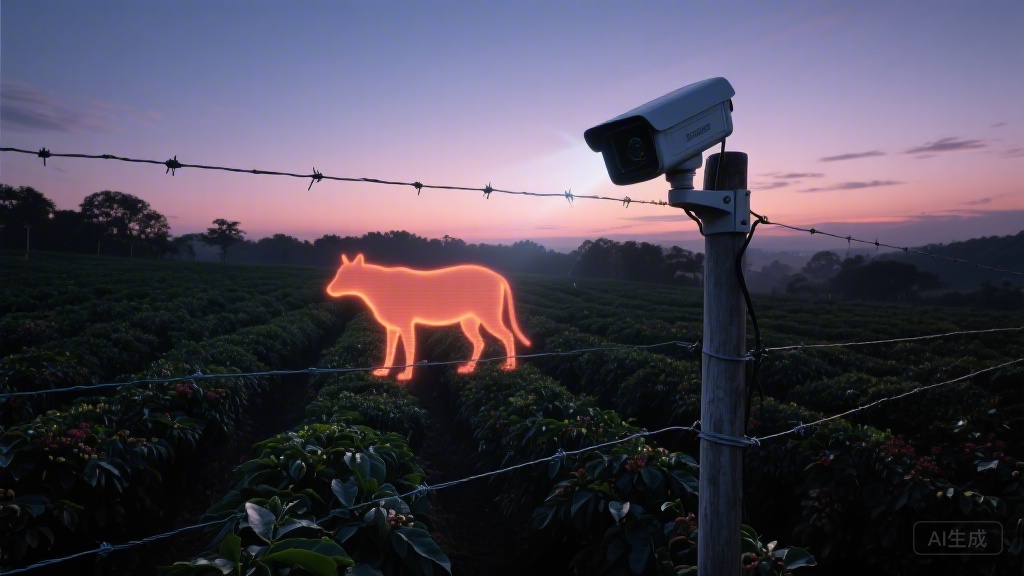
PerimeterAI thermal cameras provide 24/7 monitoring regardless of weather conditions. These units detect temperature differences as small as 0.1°C at 500-meter range, distinguishing between animals (cooler body temperature, four-legged gait) and humans (warmer signature, bipedal movement). Machine learning algorithms reduce false alarms by 95% compared to motion-only systems.
Installation follows a systematic process: First, survey the perimeter using GPS to identify natural chokepoints and vulnerable areas. Second, install solar-powered repeater stations every 800 meters to ensure LoRa network coverage. Third, mount thermal cameras at 15-meter intervals along high-risk zones, with overlapping fields of view to eliminate blind spots.
AlertShield panic buttons complete the human safety layer. Each device weighs just 45 grams, operates for 2+ years on a single battery, and transmits GPS coordinates plus worker ID when activated. The LoRa protocol works even when cellular networks fail—critical during emergencies when conventional communication often breaks down.
The system integration elevates individual components into intelligent security infrastructure. When thermal cameras detect unusual movement, they automatically redirect nearby drones for closer inspection. If panic buttons activate, the system immediately dispatches security personnel while alerting emergency contacts via multiple channels. This coordinated response transforms reactive security into predictive protection.
AustinEco Equipment Manifest: Your Shopping List
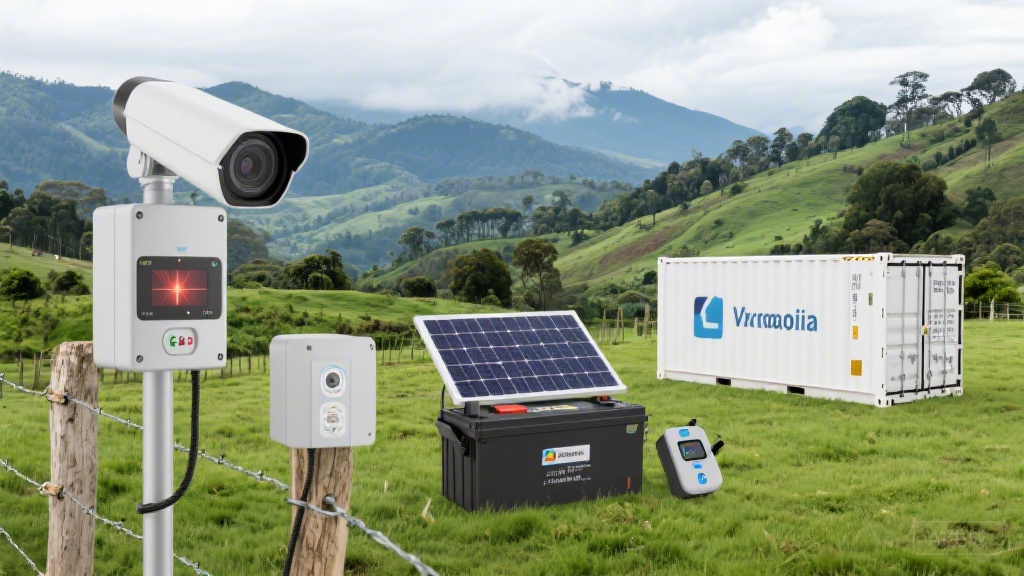
Security Infrastructure:
• FenceGuard Pro Series - 15km electric barrier kit, solar-powered, HS Code 8544.42, $8,500 (vs. $25,000 Western equivalent)
• PerimeterAI Thermal-360 - Long-range thermal detection, 500m range, HS Code 9013.80, $3,200 each (12 units required)
• AlertShield Personal - LoRa panic buttons, 2-year battery, HS Code 8517.62, $85 each (50-unit pack available)
Smart Agriculture:
• CropEye Multispectral - NDVI crop monitoring drone, 45-minute flight time, HS Code 8806.21, $12,000 (vs. $35,000 Western)
• SolarGrid Micro-400 - 400W solar panels, MPPT controllers, HS Code 8541.40, $320 per panel
• ChainCold Mobile - Portable cold storage, 4°C precision, HS Code 8418.69, $4,500
Installation difficulty ranges from basic (panic buttons, solar panels) to advanced (thermal camera networks, drone integration). All systems include English documentation, video tutorials, and remote technical support. Bulk pricing available for community group purchases.
SmartTrade Integration: From Farm to Global Market
AustinEco's SmartTrade platform transforms this farm from equipment buyer into global supplier. The 56-dimension matching engine connects Kenya AA coffee with specialty roasters in Seattle, Munich, and Tokyo based on flavor profiles, processing methods, and sustainability certifications. The 22-node trade pipeline handles everything from contract negotiations to final delivery.
Equipment procurement leverages reverse logistics: the same container shipping coffee to Europe returns with processing equipment from Germany, while rose exports to Netherlands balance with greenhouse technology imports. This bidirectional trade reduces shipping costs by 40% compared to single-direction logistics.
HS code integration streamlines customs clearance—thermal cameras (9013.80) qualify for agricultural equipment duty exemptions in Kenya, while coffee exports (0901.21) access preferential tariffs under AGOA agreements. The platform's Airwallex integration handles multi-currency payments, automatically hedging foreign exchange exposure for both equipment purchases and crop sales.
For farm owners, this means one platform manages both input procurement and output marketing. Upload your coffee cupping scores, and the system matches you with roasters paying premiums for specific flavor profiles. Your roses' post-harvest handling data connects with importers requiring specific quality standards.
Take Action: Build Your Agricultural Future
Ready to transform farming challenges into opportunities? Three pathways await your engagement:
Explore the Technology: View this farm in interactive 3D using Google Maps WebGL integration. See exactly where each camera mounts, how the electric fence routes around natural obstacles, and why certain crops grow in specific microclimates.
Join the Community: Submit your co-build ideas through the AustinEco platform. Recent community suggestions have shaped real farm implementations—from solar-powered irrigation to mobile processing units. Your expertise in local conditions, crop varieties, or security challenges could solve problems for farmers worldwide.
Design Your Vision: Use the GlobalHome configurator to design your ideal farm. Start with your location, climate, and crops, then explore how different technology combinations affect your 16-dimension scores and ROI projections.
This farm is evolving through community collaboration—what would YOU build here? Whether it's improving coffee processing, enhancing worker safety, or integrating new crop varieties, your ideas shape the future of agriculture. The technology exists, the supply chains connect, and the global market awaits. The question isn't whether smart farming will transform agriculture—it's whether you'll help lead that transformation.